
What Makes a Diamond Blue? The Role of Boron
Most diamonds appear colorless. Yet every so often, nature surprises us with a vivid blue gem that seems to hold a drop of ocean inside it. That color doesn’t come from magic. It comes from chemistry. Specifically, it comes from boron.
When boron atoms slip into a diamond’s crystal lattice during formation, they alter how the stone interacts with light. A pure diamond consists of carbon atoms arranged in a tight, repeating structure. Introduce a trace element like boron, even in parts per million, and the electronic structure changes. The diamond begins to absorb red light. What remains visible to your eye is blue.
It sounds simple. In reality, the process unfolds under immense pressure and heat deep within Earth’s mantle. Boron must be present at just the right time. It must integrate into the growing crystal. Too little, and you won’t see a noticeable effect. Too much, and the stone may appear darker or even grayish blue. That delicate balance shapes some of the rarest diamonds ever found.
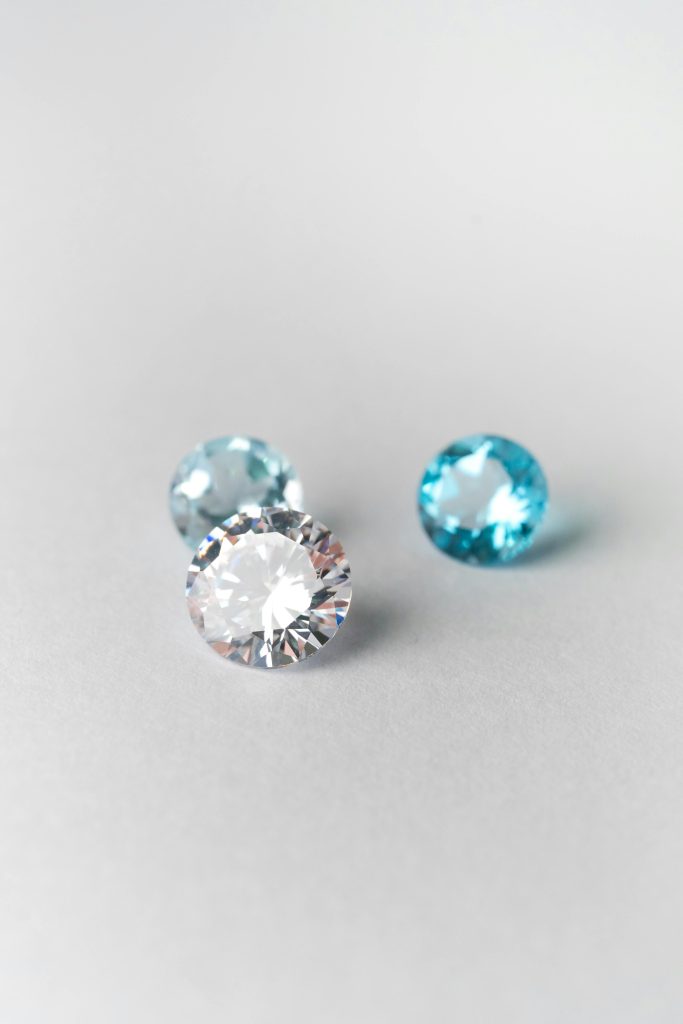
How Boron Alters Diamond Structure
To understand blue diamond formation, you need to look inside the atomic framework. A diamond’s structure forms when carbon atoms bond in a tetrahedral arrangement. Each carbon atom connects to four others. This symmetry gives diamond its strength and brilliance.
Now imagine replacing a carbon atom with a boron atom. Boron has one fewer electron than carbon. That small difference matters. It creates what scientists call an electron “hole.” These holes allow the diamond to conduct electricity. In fact, most blue diamonds are semiconductive. Colorless diamonds are not.
Because of these electron gaps, the diamond absorbs specific wavelengths of light in the red portion of the spectrum. As red light disappears, blue dominates your perception. It’s similar to filtering sunlight through tinted glass. Remove certain colors, and others stand out.
This interaction between light and trace elements explains why impurities often create color in diamonds. Nitrogen produces yellow tones. Structural distortions can create pink. Boron, however, leads to blue. Each impurity tells a different geological story.
Geological Conditions Behind Boron Incorporation
Blue diamonds don’t form everywhere. Geological evidence suggests they originate at extreme depths, sometimes deeper than most other diamond types. Some researchers link their formation to subduction zones. In these regions, oceanic crust sinks into the mantle. That crust may carry boron-rich minerals downward.
If boron travels into the mantle this way, it becomes available during diamond growth. Under pressures exceeding 20 gigapascals and temperatures above 1,000 degrees Celsius, carbon crystallizes. Boron atoms can substitute into the lattice during this process.
Interestingly, studies of famous blue diamonds such as the Hope Diamond suggest a deep mantle origin. Inclusions trapped inside these stones sometimes reveal minerals that form far below typical diamond depths. That discovery reshaped scientific thinking. Blue diamonds may offer clues about Earth’s interior chemistry.
So when you look at a blue diamond, you’re not just seeing color. You’re seeing a fragment of deep planetary history.
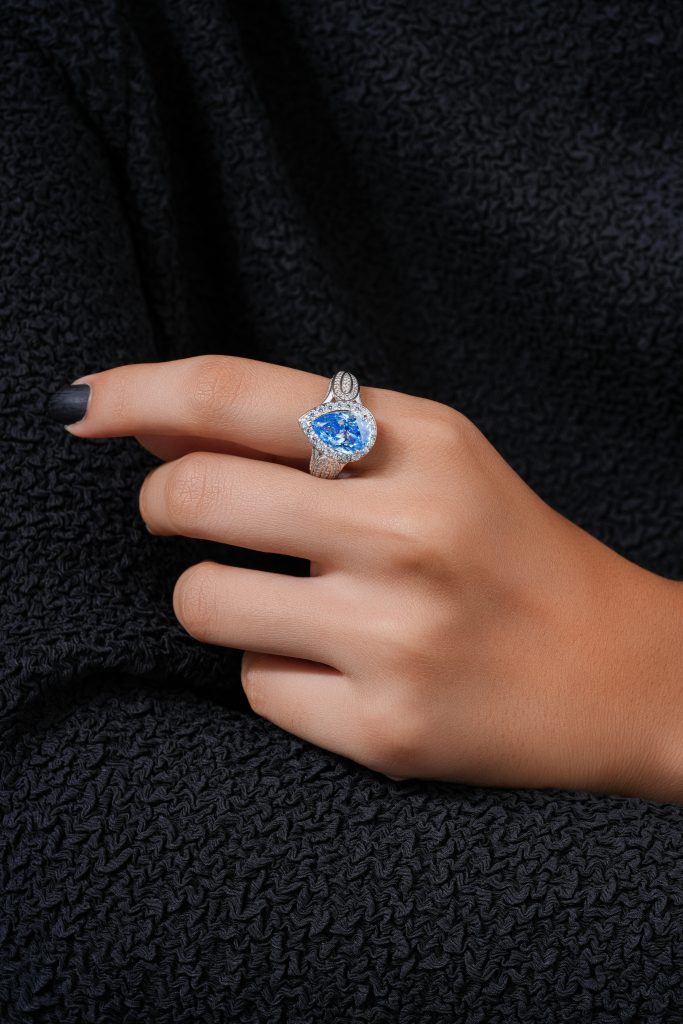
Famous Blue Diamonds and Their Boron Signature
Throughout history, several blue diamonds have captured global attention. The Hope Diamond remains the most well-known example. Its deep blue tone reflects measurable boron content. Scientific analysis confirmed its semiconductive behavior, which aligns with boron substitution.
Another remarkable stone, the Blue Moon of Josephine, demonstrates how even small variations in boron concentration can influence saturation. Some stones display a soft sky-blue shade. Others appear intense and velvety.
Color intensity depends on boron concentration and distribution. Uniform dispersion creates consistent tone. Uneven presence may produce zoning. That subtle variation can affect grading and market value.
However, rarity drives much of the fascination. Blue diamonds represent a tiny fraction of all natural diamonds. Their unusual chemistry and deep-earth origin elevate their scientific and commercial significance.
Natural vs. Lab-Grown Blue Diamonds
Modern technology can replicate blue coloration. Laboratories use methods such as High Pressure High Temperature (HPHT) treatment to introduce boron during growth. These lab-grown diamonds share similar chemical characteristics with natural stones. They can even exhibit semiconductivity.
Still, formation history differs. Natural blue diamonds crystallize over billions of years under geological forces. Lab-grown versions form within weeks. While both contain boron, their growth environments contrast sharply.
Gemological laboratories analyze trace elements, growth patterns, and inclusions to determine origin. Advanced spectroscopy detects boron concentrations. Growth structures visible under magnification may reveal whether the diamond formed in Earth’s mantle or a controlled chamber.
For buyers and researchers alike, understanding boron’s role helps interpret these distinctions. Chemistry doesn’t lie. It leaves fingerprints in the crystal.
Why Boron Matters Beyond Color
Boron does more than create a blue hue. It influences electrical behavior, optical absorption, and even research applications. Because blue diamonds conduct electricity, scientists study them for potential semiconductor uses. Synthetic boron-doped diamonds already serve in specialized electronics.
From a gemological perspective, boron concentration helps determine grading classification. Laboratories measure intensity, tone, and saturation. Slight shifts in atomic content can change how a diamond appears under different lighting.
In a way, boron acts like a quiet architect. You don’t see it directly. Yet its presence transforms the entire structure. Without it, blue diamonds wouldn’t exist.
Conclusion: A Trace Element with Immense Impact
At first glance, boron seems insignificant. It appears only in tiny amounts. Yet those few atoms redefine a diamond’s identity. They change how light travels. They alter electrical properties. They connect the stone to deep geological processes beneath Earth’s surface.
Blue diamonds remind us that small differences matter. A single missing electron per atom shifts the entire visual outcome. Chemistry shapes beauty in ways you might never expect.
Next time you see a blue diamond, consider what you’re really observing. It’s not just color. It’s physics, geology, and atomic structure working together in perfect balance.